Resources

Manuals and guides that keep every dive on track


Climate Fish Protocol

The Climate Fish Protocol guides divers step by step on how to monitor Mediterranean fish communities underwater. By following the instructions to record key native and non-indigenous species, you provide crucial data that helps scientists track how fish respond to climate change.

Target Species

Native Species (7)

  • Parrotfish (Sparisoma cretense)
  • Dusky grouper (Epinephelus marginatus)
  • Ornate wrasse (Thalassoma pavo)
  • Salema porgy (Sarpa salpa)
  • Painted comber (Serranus scriba)
  • Mediterranean rainbow wrasse (Coris julis)
  • Comber (Serranus cabrilla)

Observed Exotic Species (5)

  • Lionfish (Pterois miles)
  • Rabbitfish (Siganus luridus)
  • Rivulated rabbitfish (Siganus rivulatus)
  • Blue-spotted cornetfish (Fistularia commersonii)
  • Redbait (Sargocentron rubrum)

What You Need

Underwater board

Pre-printed underwater board for data collection and pencil

Underwater watch

Underwater watch to measure 5-minute transects
Thermometer

Computer or thermometer to record water temperature

Where & When

Sampling Sites

Rocky bottoms only, with moderate slopes. Sandy bottoms or Posidonia oceanica meadows must be avoided.

Depth ranges: 1-3 m, 5-10 m, 11-20 m, 21-30 m

Shallow (1–3 m) surveys can be done by either SCUBA or snorkeling on the surface.

Monitoring Period

All year round.

Recommended: between August and October, every year.

Re-visits of sites are strongly encouraged.

Sampling Design

1 Select at least 3 permanent locations spaced ~500 m apart.
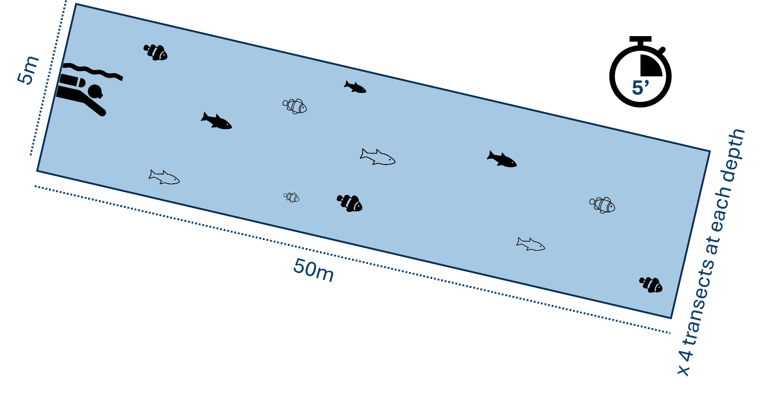
2 At each location and depth range, complete 4 consecutive transects.
3 Choose one or more depth ranges per dive.
4 Work in teams: one diver counts fish, the other controls time and depth.
5 Shallow depth (1–3 m) is the priority and can be monitored alone.

How to Count Fish

1 Swim very slowly for 5 minutes (~50 m, 10 m/min).
2 Count all target species within a 2.5 m radius (5 m wide transect).
3 Do not count fish smaller than 2 cm.
4 Once you finish the first transect you can proceed in the same direction starting a new transect.

Climate Fish transect diagram showing depth ranges and sampling method

The Climate Fish protocol was adapted from the CIESM project Tropical Signals existing framework and was tailored specifically to the context of Alonnisos.


Reef Check Protocol

The Reef Check Protocol guides divers step by step on how to monitor the health of Mediterranean rocky reefs underwater. By following the instructions to monitor presence, absence and abundance of key species and note signs of stress or change, you provide valuable data that helps scientists track ecosystem health.

Target Species

How Species Were Chosen

  • Easily observable and identifiable underwater
  • Protected or non-indigenous species
  • Sensitive to climate change
  • Ecosystem engineers
  • Threatened or commercially exploited species

Flexible Observations

  • Participants may focus on any number of the 20 proposed species, based on habitat type and confidence level.
  • When species-level identification is difficult, observations can be recorded at genus level (e.g. seahorses).

What You Need

Underwater board

Pre-printed underwater board for data collection and pencil

Underwater watch

Underwater watch or dive computer to track time and depth

Where & When

Sampling Sites

Surveys are conducted only on rocky reefs. Sandy bottoms or Posidonia oceanica meadows must be avoided.

No depth limitation. SCUBA or snorkeling are both suitable for surface observations.

Monitoring Period

Year-round monitoring.

Re-visits of sites are strongly encouraged.

Habitat Types

Coastal rocky reefs
Offshore rocky reefs
Rocky cliff (wall dive)
Cave
Artificial substrates (e.g. wrecks)


Underwater Survey Method

1 Actively search for selected species across the reef.
2 Record abundance using numerical or descriptive classes.
3 Note the minimum and maximum depth where each species is observed.
4 Assign the habitat type from a predefined list.
5 Record species searched for but not encountered as absent.
6 Log total depth range and dedicated observation time.

Report Observed Threats & Stressors

1 Coral diseases (e.g. bleaching and necrosis) and injuries
2 Epibionts overgrowth
3 Species threatened by abandoned fishing lines and nets
4 Mass mortality events
5 Mucilaginous algal bloom

Tips for Participants

Choose species you are more confident with (probably reducing errors), those you like the most (making the diving experience more satisfactory), or limit yourselves to a number of species you feel able to handle (which reduces pressure).

The Reef Check protocol was adapted from the existing Reef Check Med Underwater Coastal Environment Monitoring Protocol (RCMed U-CEM) and was tailored specifically to the context of Alonnisos.

Protocol Manuals

Download the latest versions of our field manuals and prep guides before you head to the water.

English Manual

Full protocol walkthrough in English, including survey prep, data sheets, and safety notes.

Download

Greek Manual

Everything the English manual offers, localized for Greek-speaking divers and facilitators.

Download

Species ID Guide

Illustrated quick-reference guide to help teams identify priority species during both protocols.

Download